Luxembourg rental yields 2025: where do landlords actually earn?
Gross rental yields by commune for Luxembourg apartments in 2025. Esch-sur-Alzette leads at 8.40% gross, Strassen pays 4.76%, Kopstal trails at 3.52%. Paired with the Observatoire de l'Habitat's 2025 asking-rent and hedonic-sale data.
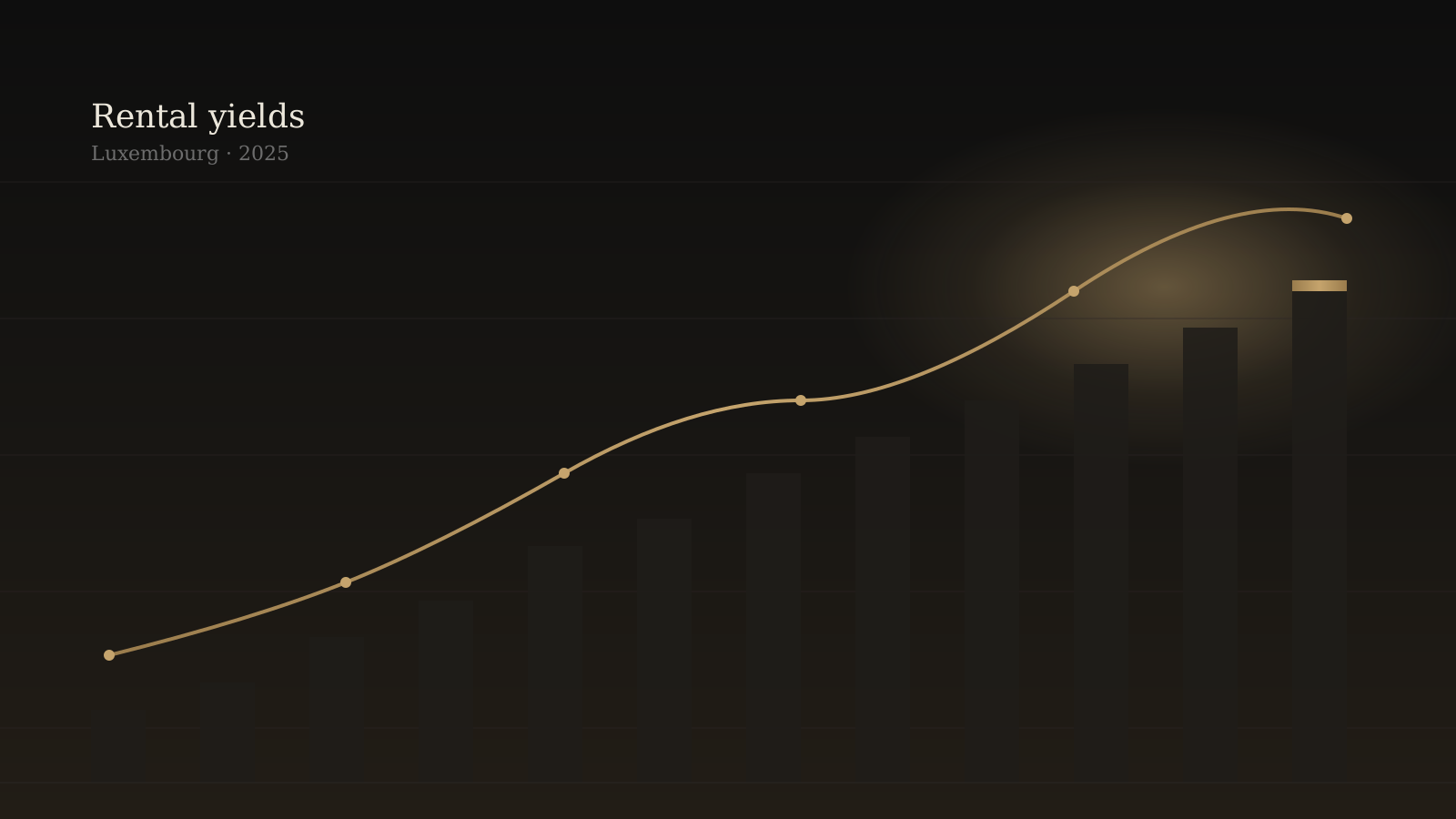
If you are buying in Luxembourg to rent out, the commune you choose matters more than almost any other decision. In 2025, the gross rental yield on a standard apartment runs from 3.52% in Kopstal to 8.40% in Esch-sur-Alzette — the same building, the same square metre, two very different investment cases. This post walks through the 2025 yield landscape commune by commune, pairing the Observatoire de l'Habitat's hedonic sale prices with its asking-rent series, and then checks the numbers against what an actual landlord puts in their pocket after taxes, vacancy, and the syndic bill.
How yield is calculated here
Gross rental yield is a ratio: annual rent divided by purchase price, expressed as a percentage. We pair two Observatoire indicators at the commune level: the hedonic €/m² for Q4 2025 apartment sales (a quality-adjusted price that controls for size and vintage), and the 2025 average €/m²/month asking rent (the price landlords were requesting, not a transaction rent). Both series are from the same dataset, both are published on data.public.lu under a CC0 licence. The formula is: yield = rent €/m²/mo × 12 ÷ buy €/m² × 100.
We only show communes that publish both indicators. That leaves 31 communes with enough sales and enough rent offers to trust the number. The Observatoire suppresses figures for communes with fewer than ten observations, which is why half of Luxembourg's 102 communes (mostly small rural ones) do not appear here. We do not fill the gaps.
The south basin is the yield leader
The five best-yielding communes in 2025 all sit in the former steel basin south of the capital, with the single exception of Luxembourg-Ville itself. These markets share the same structural feature: sale prices moved down after the 2022–2023 correction while rents stayed firm, lifted by French cross-border workers who pay in euros and do not want to commute through Dudelange twice a day.
- Esch-sur-Alzette — 8.40% · €5,911/m² buy · €41/m²/mo rent · 541 rent offers
- Mondercange — 8.33% · €6,380/m² buy · €44/m²/mo rent · 61 rent offers
- Käerjeng — 6.87% · €6,319/m² buy · €36/m²/mo rent · 109 rent offers
- Luxembourg-Ville — 5.99% · €9,103/m² buy · €45/m²/mo rent · 5535 rent offers
- Schifflange — 5.94% · €6,607/m² buy · €33/m²/mo rent · 86 rent offers
Esch-sur-Alzette is the cleanest case study: the second-largest rental market in the country with 541 offers in 2025, apartments still change hands around €5,911/m² hedonic, and rents average €41.36/m²/month. That arithmetic gives an 8.40% gross yield — roughly 3.4 percentage points better than the capital, in exchange for a 10-minute drive. Mondercange (8.33%) and Käerjeng (6.87%) tell the same story with smaller samples. Luxembourg-Ville is the surprise in the top five: it yields 5.99% despite being the most expensive apartment market in the country, because rental demand is so intense that €45/m²/month is the floor, not the ceiling.
The premium western belt is where yield goes to die
The five weakest-yielding communes sit mostly in the premium western ring or the quiet northern periphery. In both cases the same dynamic kills the yield: sale prices are anchored high either by scarcity (Kopstal, Contern) or by a thin rental market that can't absorb premium €/m²/month asks (Clervaux, Weiswampach).
- Kopstal — 3.52% · €9,045/m² buy · €27/m²/mo rent · 41 rent offers
- Contern — 3.69% · €7,699/m² buy · €24/m²/mo rent · 32 rent offers
- Diekirch — 3.91% · €6,457/m² buy · €21/m²/mo rent · 75 rent offers
- Mersch — 4.14% · €6,629/m² buy · €23/m²/mo rent · 69 rent offers
- Clervaux — 4.16% · €5,500/m² buy · €19/m²/mo rent · 69 rent offers
Kopstal at 3.52% is the extreme case: a €9,045/m² buy paired with only €26.56/m²/month in rent. It is a lifestyle commune, not an investor commune — people buy there to live, not to rent out. Contern (3.69%) is similar, with the added twist that the low offer count (32 rent ads in 2025) means a single bad month can push the yield below 3%.
The capital sits exactly at the national median
One reason Luxembourg-Ville looks attractive from a yield angle is the absolute size of the rental market there: 5,535 apartment rent offers in 2025, ten times the second-place commune. That volume means a landlord can re-let a unit in weeks, not months — which materially affects effective yield once you factor vacancy. The national median yield across the 31 communes in this ranking is 4.83%, so the capital at 5.99% sits comfortably above the middle of the pack despite its premium prices.
Gross yield is a marketing number — here's the net
The number you see in the chart above is the gross yield. An actual landlord in Luxembourg needs to deduct, at minimum:
- Property tax (impôt foncier) — modest in absolute terms, typically a few hundred euros per year for an average apartment, but varies meaningfully by commune.
- Syndic / co-ownership charges — roughly €2–3/m²/month for apartment buildings, or €1,500–2,700 per year on a 75 m² flat. This is the single largest deduction.
- Maintenance + major works — budget 0.5% of the apartment value per year on average (roughly €2,500 on a €500k unit), higher for older buildings.
- Vacancy + re-let cost — even in Luxembourg, plan for one month of empty time every couple of years, plus any agency fee charged to the landlord where applicable.
- Income tax — rental income is taxed at the landlord's marginal rate. For a resident buyer in the 38–42% bracket this is the biggest single item, though mortgage interest and depreciation offset it.
As a rule of thumb, these deductions eat roughly 1.0 to 1.5 percentage points off the gross yield before tax, and another 1.0 to 1.5 percentage points after tax for a resident landlord at the marginal bracket. An 8% gross in Esch-sur-Alzette typically lands around 6–6.5% pre-tax net and 4–5% post-tax net. A 4% gross in Kopstal — which is what the headline chart gives you — lands closer to 2–2.5% pre-tax net and 1–1.5% post-tax net, which is why most serious investors skip the premium western belt entirely.
What this means if you are buying to rent
Three practical takeaways. First, the south basin (Esch, Mondercange, Käerjeng, Differdange, Schifflange) is the only part of Luxembourg where gross yields clear 5.8% on apartments in 2025, and the rent market is deep enough that vacancy risk is manageable. Second, Luxembourg-Ville's 5.99% gross is a better number than most people assume because the 5,535-strong rental offer pool keeps vacancy near zero — effective net yield is often better than in smaller communes at nominally higher gross. Third, communes with fewer than 50 rent offers per year (Mertert, Frisange, Lorentzweiler, Contern, Wiltz) are thin markets where a single tenant problem can wipe out a year of cashflow; size the rent deposit and contingency accordingly.
If you want a property-level yield estimate rather than a commune headline, our free valuation tool combines these same Observatoire indicators with property-specific inputs (surface, energy class, parking) to compute both the buy side and the rent side for a specific unit. The €19 detailed report includes a full commune-yield comparison plus a ±7% price range, which is typically what buyers bring to a notary meeting.
Sources and limitations
All numbers in this post come from the Observatoire de l'Habitat, released by the Luxembourgish Ministry of Housing and STATEC and republished on data.public.lu under a CC0 open licence. The hedonic sale price is from the Q4 2025 release; the asking rent is from the 2025 annual release (the rent dataset lags the sales dataset by one quarter in publication). Both are averages — not individual transactions — so use them as market anchors, not as property-level valuations.
Limitations to keep in mind: asking rent is not transaction rent. In a tight market the two are close; in a soft market landlords ask more than they close at. Gross yield is a point-in-time snapshot; a commune that yields 8% in 2025 can yield 5% in three years if rents soften faster than prices. And finally, the yield is for an average apartment: two units in the same commune can yield 3 percentage points apart based on floor, energy class, and condition. Use the headline to locate, not to price.
Last updated: April 2026 · Data: Observatoire de l'Habitat via data.public.lu